
Best Ad Tracking Tools for Ecommerce in 2025
A realistic, software-focused comparison of the leading attribution and ad tracking platforms used by Shopify brands, paid media buyers, and ecommerce agencies — including WeTracked, Triple Whale, Northbeam, Hyros, and Elevar.
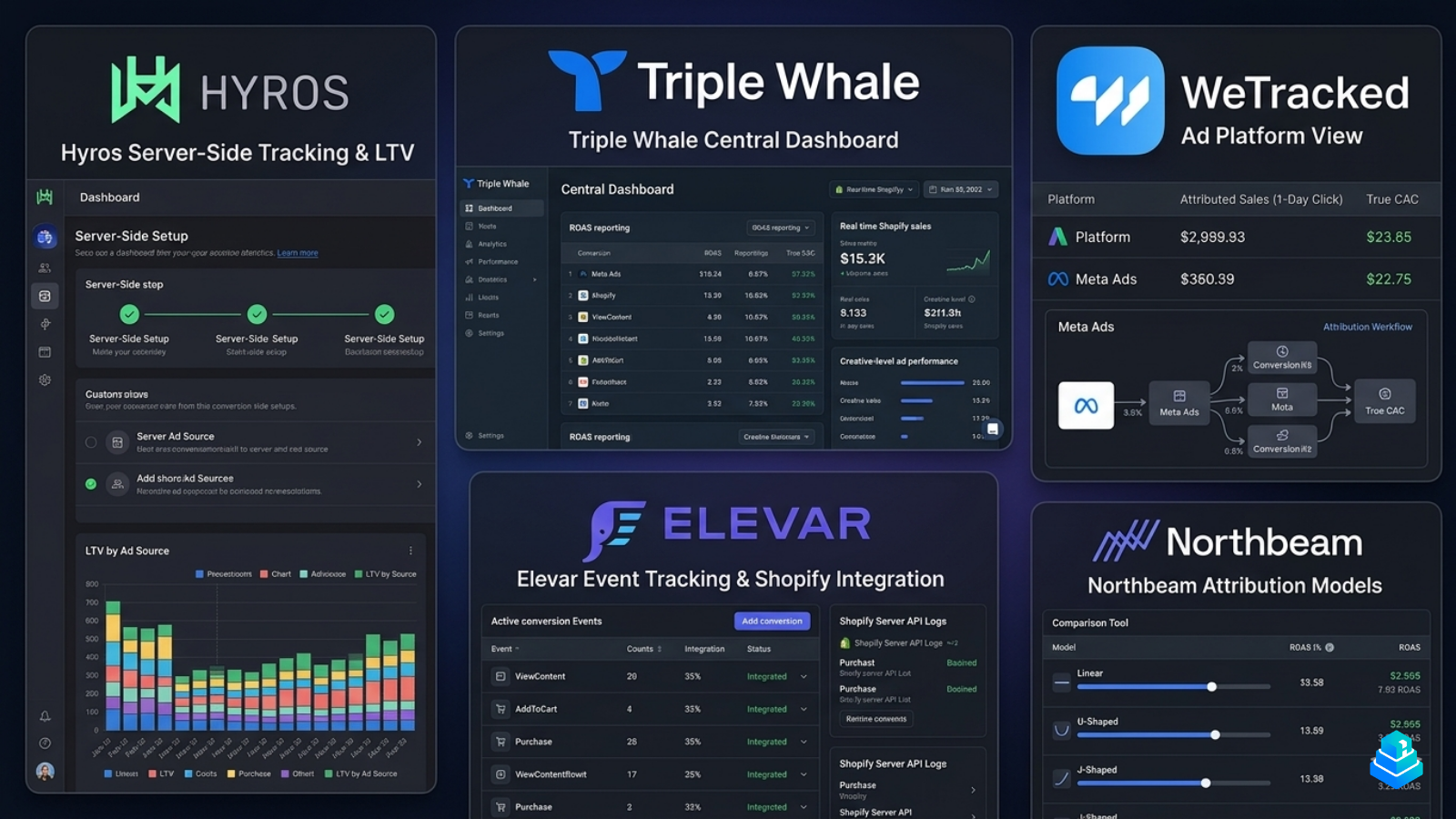
Ecommerce attribution has become significantly more fragmented over the past few years. iOS tracking changes, the broad shift to server-side event collection, and growing inconsistencies between ad platform reporting have forced brands to rethink how they measure paid media. The tools that ecommerce teams once relied on for a single source of truth are now part of a wider stack — each focused on a different layer of the attribution problem.
Some platforms focus on lightweight attribution visibility and operational reporting. Others emphasize centralized analytics, advanced modeling, or server-side data infrastructure. None of them solve attribution completely, and any honest evaluation has to acknowledge that. We tested several of the most commonly adopted platforms across realistic Shopify and Meta-heavy workflows to understand where each tool genuinely fits.
This guide is intentionally editorial. There are no affiliate redirects, no ranked "winners," and no claims that any single tool will fix attribution for every brand. The goal is to help operators understand what each platform is actually built for, so the choice depends on workflow fit rather than marketing copy.
Quick comparison of the platforms
The table below summarizes how each platform tends to be positioned in practice. Pricing is approximate and changes frequently — always verify directly with the vendor before committing.
| Tool | Best For | Attribution Style | Shopify Focus | Ease of Use | Starting Pricing |
|---|---|---|---|---|---|
| WeTracked | Lightweight Meta attribution | Click + server-side events | Strong | Easy | ~$49/mo |
| Triple Whale | Centralized ecommerce analytics | Pixel + post-purchase survey | Strong | Moderate | ~$129/mo |
| Northbeam | Advanced attribution + MMM | Multi-touch + data-driven modeling | Moderate | Steeper | Custom (enterprise) |
| Hyros | Paid media tracking depth | Server-side click tracking + LTV | Cross-vertical | Moderate | Custom (mid-market) |
| Elevar | Server-side tracking infra | Event-level (CAPI / sGTM) | Very strong | Moderate | ~$50–$300/mo |
How we evaluated these tools
Attribution platforms are difficult to evaluate fairly because most brands only ever use one or two of them in production. To stay grounded, we anchored our evaluation in the workflows that actually drive day-to-day decisions inside Shopify-led ecommerce teams.
- Attribution visibility. How clearly each tool reports attributed revenue, ROAS, and CAC across Meta, Google, TikTok, and email — and how the underlying model is explained to the user.
- Meta reporting workflows. Whether the platform feels built around the realities of Meta's CAPI, deduplication, and 1-day vs 7-day click reporting.
- Shopify integrations. Quality of the native Shopify connection, including order-level data, customer LTV, and refund handling.
- Event matching quality. How well purchase events are deduplicated, enriched, and matched back to the original ad click.
- Dashboard usability. Whether marketers can navigate the UI without engineering help, and how reporting handles common edge-cases.
- Reporting depth. Availability of attribution windows, cohort views, creative-level breakdowns, and exportable reports.
- Operational simplicity. Setup time, ongoing maintenance, and how often the team has to re-validate data.
Best ad tracking tools, reviewed
Each of the platforms below earns its place in the conversation for a different reason. Rather than rank them, we describe what they're genuinely good at, and where the trade-offs surface in real workflows.
1. WeTracked — lightweight attribution for operational teams
WeTracked positions itself as a focused attribution layer rather than a full ecommerce analytics suite. The product is built around Meta-heavy Shopify advertisers who want a clear, day-to-day view of attributed revenue, true CAC, and creative-level performance — without standing up an enterprise reporting stack.
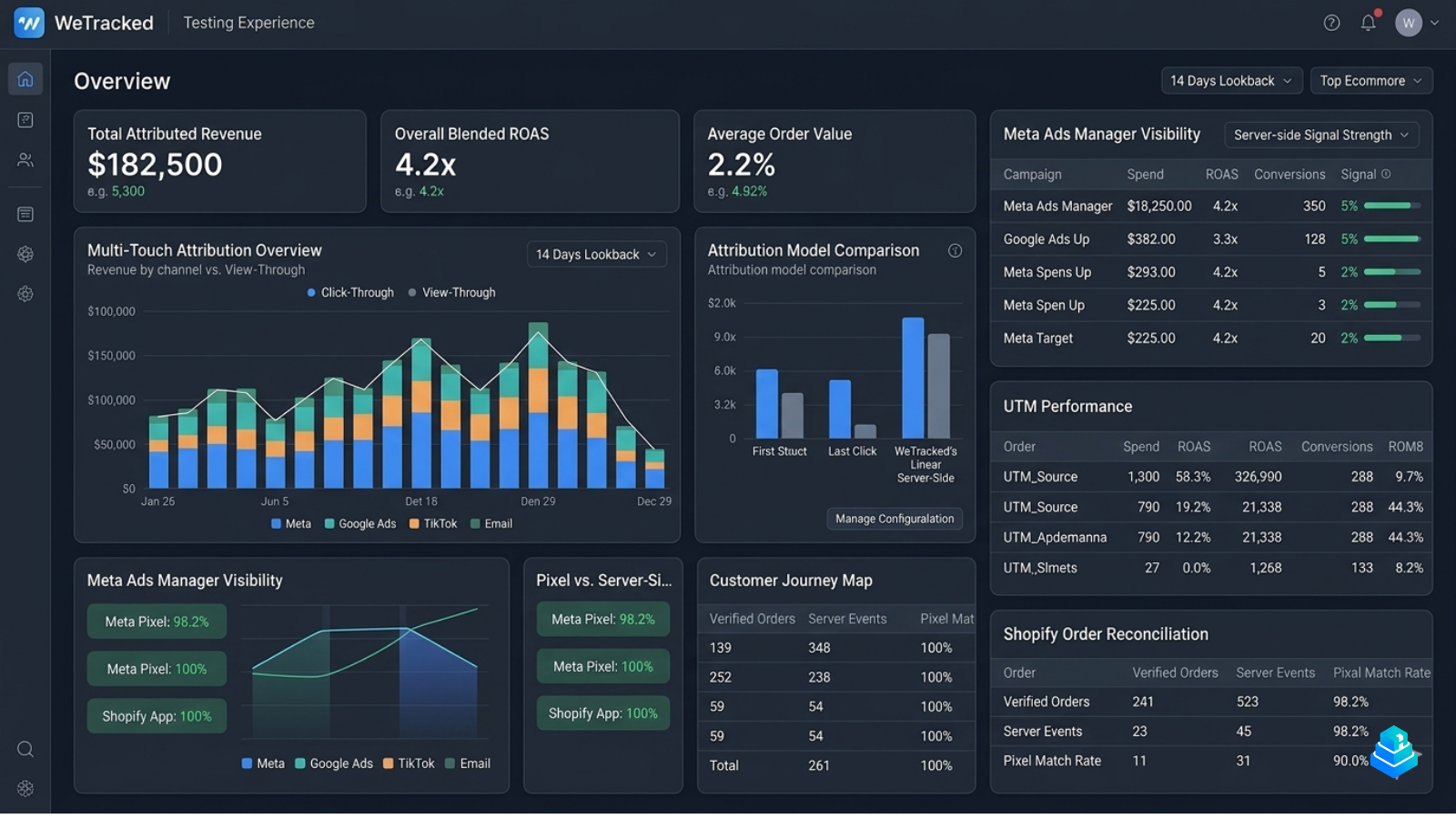
In testing, the dashboard feels intentionally restrained. The default views surface attributed sales by ad platform, true CAC alongside reported CAC, and a Meta-centric attribution workflow that visualizes how conversions are matched back to the original click. For brands that mainly need to answer "is this campaign actually working?", the surface area is small enough to learn in an afternoon.
Strengths
- Fast Shopify connection and minimal setup overhead
- Clear separation between platform-reported and tool-reported numbers
- Server-side event sending into Meta CAPI is built in
- Pricing scales reasonably for small and mid-sized stores
Limitations
- Less suited to brands needing deep multi-touch modeling
- Reporting is Meta-first; Google and TikTok depth is more limited
- Not a replacement for a full ecommerce analytics platform
Read the dedicated WeTracked review or the head-to-head WeTracked vs Triple Whale comparison for a deeper breakdown.
2. Triple Whale — centralized ecommerce analytics
Triple Whale has become one of the most recognizable ecommerce analytics platforms in the Shopify ecosystem. Where WeTracked stays narrow, Triple Whale tries to be the central dashboard for the entire brand — combining ad attribution, Shopify performance, creative analytics, post-purchase survey data, and a growing set of agentic reporting features.
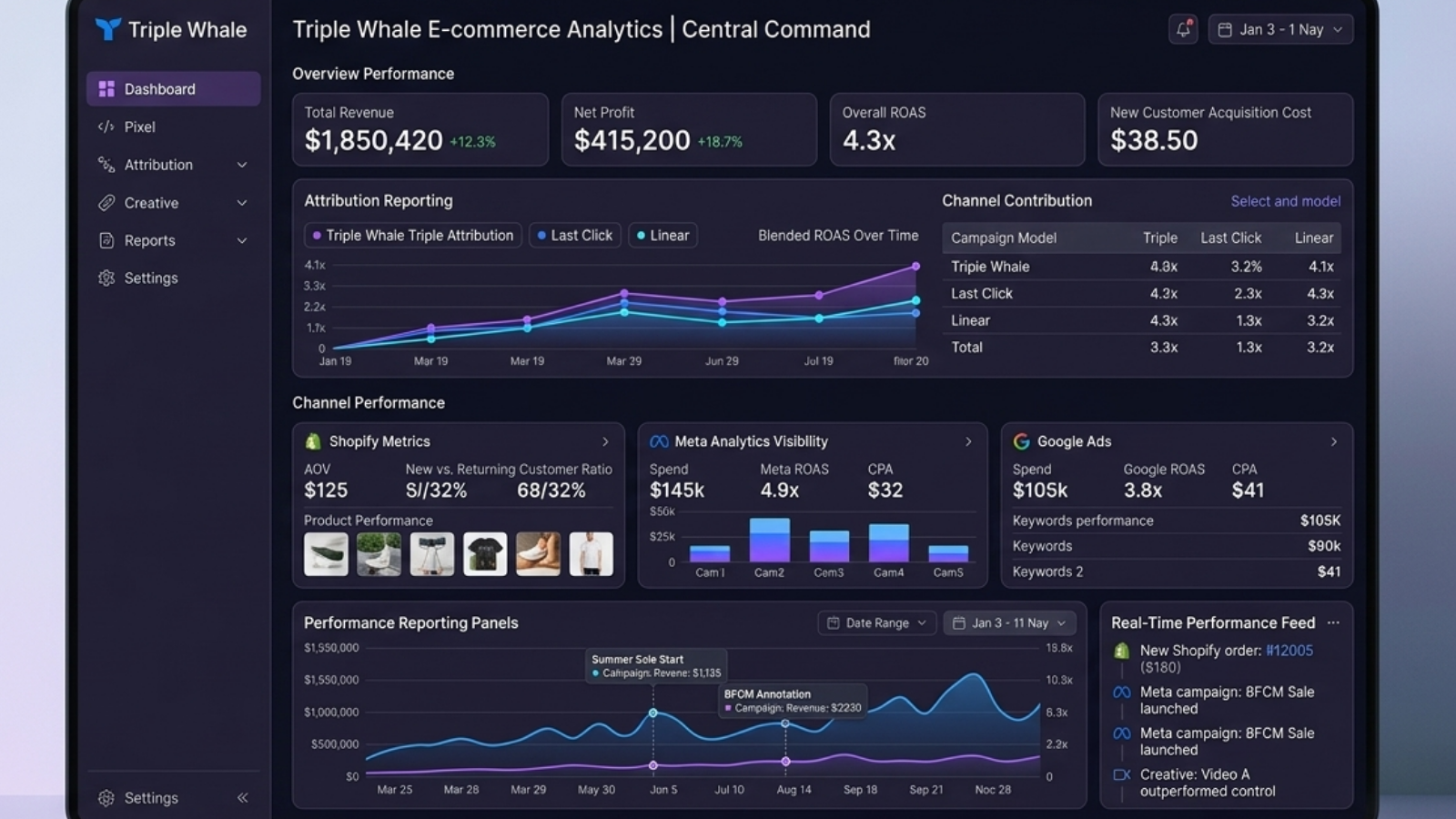
In day-to-day use, the central dashboard does a good job of consolidating spend, revenue, and ROAS across channels. Sonar (its server-side pixel) and the post-purchase survey integration give the attribution layer more inputs than a standard click-based model. The trade-off is surface area: Triple Whale has a lot of features, and small teams sometimes use only a fraction of what they're paying for.
Strengths
- Strong centralized view across Shopify and major ad platforms
- Sonar pixel and post-purchase surveys feed the attribution model
- Healthy ecosystem of integrations and reporting templates
- Useful for brands consolidating multiple analytics tools
Limitations
- Pricing scales quickly with revenue and seat count
- Onboarding and configuration take meaningful time
- Attribution model can feel opaque without deliberate setup
3. Northbeam — advanced attribution and media mix modeling
Northbeam is built for teams whose primary question is "how should we reallocate spend?" rather than "what did Meta report yesterday?" The platform leans into multi-touch attribution, data-driven models, and a media mix modeling layer designed for brands spending enough that the modeling assumptions actually matter.
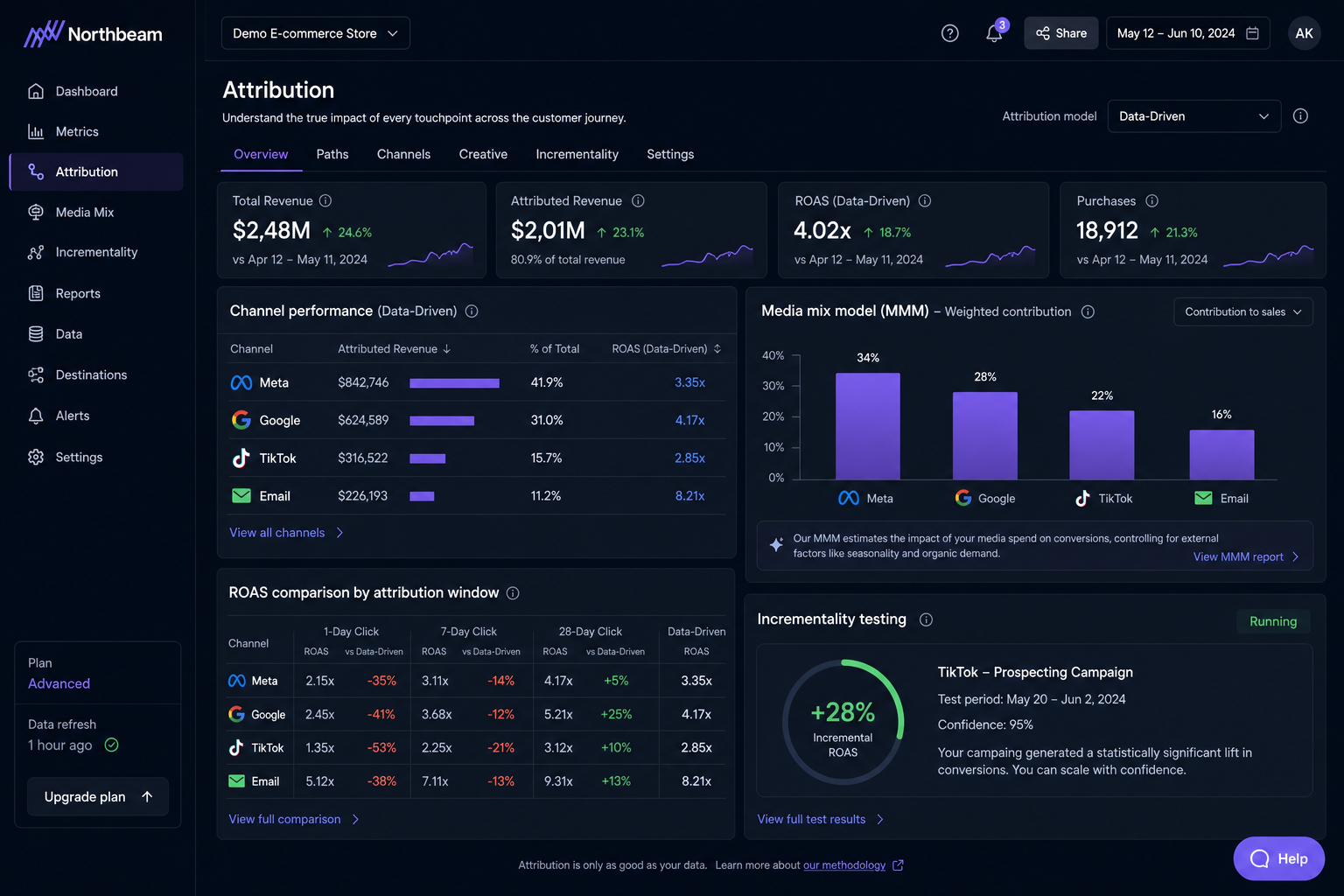
The dashboard exposes channel-level contribution under different attribution windows side-by-side, which is genuinely useful when teams need to explain why their internal numbers differ from Meta's reported ROAS. Incrementality testing and MMM views push the platform into territory most lighter tools don't attempt.
Strengths
- Multi-touch and data-driven attribution feel mature
- Media mix modeling and incrementality testing built in
- Useful for justifying budget reallocations across channels
- Strong fit for brands with significant spend across 3+ platforms
Limitations
- Higher price point and longer onboarding cycle
- Requires analytical maturity to interpret outputs correctly
- Often overkill for stores under a certain spend threshold
4. Hyros — server-side click tracking and LTV reporting
Hyros has historically been associated with info-product and high-AOV verticals, but its underlying approach — long-window server-side click tracking combined with LTV-aware reporting — has relevance to ecommerce brands with longer consideration cycles or subscription components.
In practice, Hyros emphasizes the tracking layer itself: how clicks are captured, how identity is stitched across sessions, and how those clicks are credited against eventual revenue. The reporting feels closer to a paid-media analytics tool than a Shopify-native dashboard, which can be a strength or a friction point depending on the team.
Strengths
- Long-window server-side tracking suits longer purchase cycles
- LTV-oriented reporting beyond first-purchase attribution
- Useful for brands running across multiple traffic sources
Limitations
- Less Shopify-native than Triple Whale or Elevar
- Pricing and onboarding aimed at established advertisers
- Reporting takes time to learn vs. lighter dashboards
5. Elevar — server-side tracking infrastructure for Shopify
Elevar plays a different role than the attribution dashboards above. It is primarily a tracking infrastructure tool — the layer that captures ecommerce events from Shopify and forwards them to destinations like Meta CAPI, Google Ads, TikTok Events API, GA4, and Klaviyo with high event match quality.
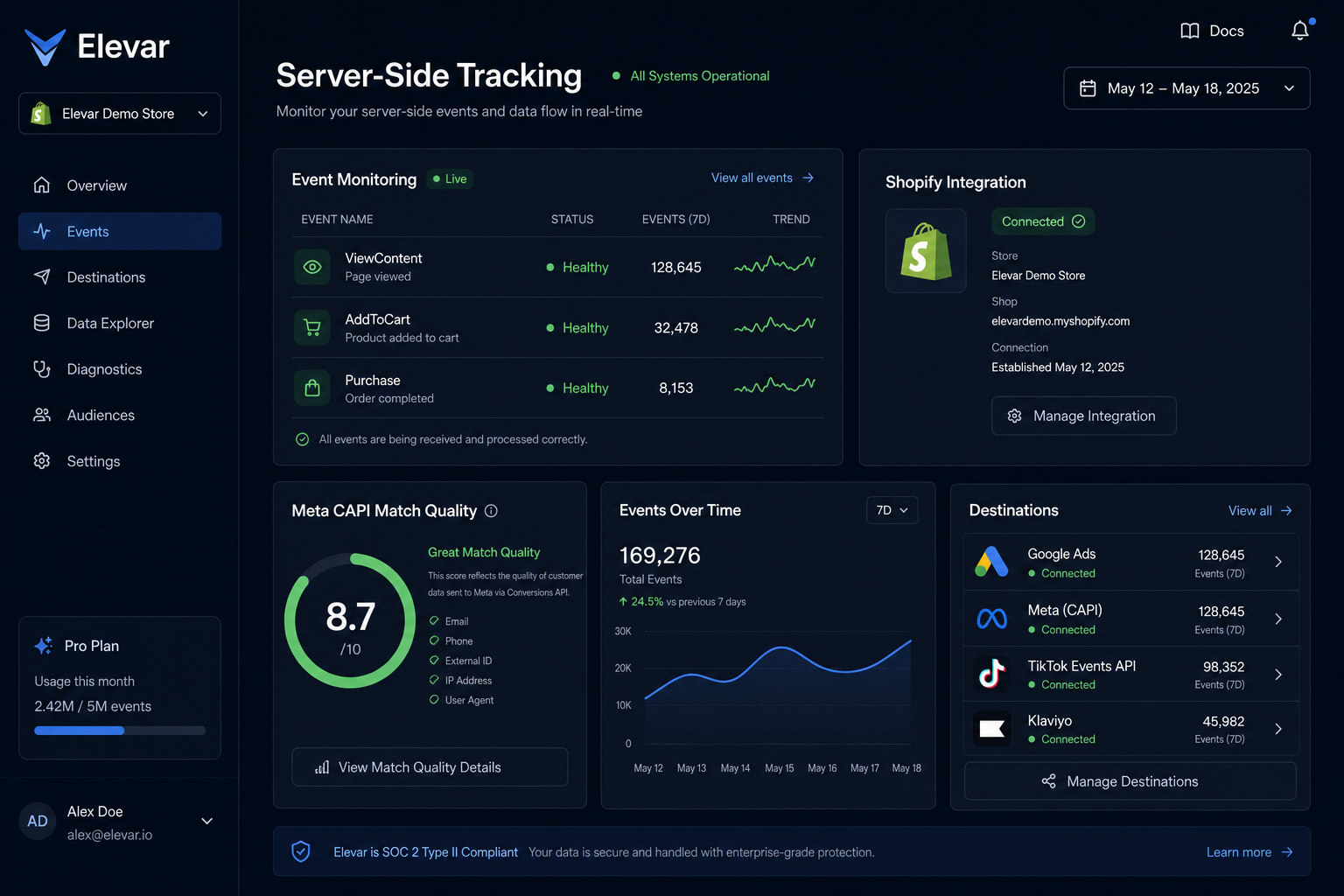
For Shopify brands, Elevar often sits underneath whichever attribution tool the team uses for reporting. The event monitoring views, CAPI match quality scoring, and destinations panel are designed to give engineering and marketing teams a shared view of whether tracking is actually healthy. If you've ever debugged duplicate purchase events or low match quality, the value here is immediate.
Strengths
- Best-in-class server-side tracking for Shopify
- High event match quality across Meta, Google, TikTok, Klaviyo
- Strong observability for the tracking layer itself
- Often pairs well with a separate attribution dashboard
Limitations
- Not an attribution tool by itself — pairs with reporting layer
- Initial setup benefits from technical involvement
- Pricing scales with monthly event volume
For more on the underlying topic, see our server-side tracking guide.
Which tool fits which kind of Shopify brand?
The honest answer is that "best" depends almost entirely on team size, spend level, and how decisions are made. The patterns below are what we see most often in practice.
Small Shopify stores ($0–$100k/mo)
Operational simplicity tends to win. Lighter tools like WeTracked, or a clean Elevar setup paired with native Shopify analytics, usually cover the day-to-day decisions without the overhead of a full analytics suite.
Scaling ecommerce brands ($100k–$1M/mo)
This is where the stack often splits. Many brands run Elevar underneath for tracking quality, and either Triple Whale or WeTracked on top for attribution and reporting. Northbeam starts becoming relevant once spend is genuinely diversified across channels.
Enterprise brands and high-spend operators
At this level, MMM and incrementality testing become more meaningful, and Northbeam or comparable platforms tend to lead the conversation. Tracking infrastructure is usually handled by Elevar or a custom server-side GTM setup.
Agencies and paid media operators
Agencies typically value tools that produce defensible numbers across multiple clients. WeTracked and Triple Whale are common in Meta-heavy portfolios; Northbeam is more common where clients are spending across diversified channels and need MMM-style narratives.
Common limitations of ad tracking tools
Any platform that claims to fully solve attribution should be treated with skepticism. The categories below show up in almost every tool we tested, and understanding them is more important than picking a "winner."
The most useful attribution tool is the one your team actually trusts enough to act on — not the one with the most impressive model.
- Attribution inconsistencies. Two tools looking at the same store will rarely produce identical numbers. Different attribution windows, modeling assumptions, and pixel coverage all introduce variance.
- Reporting gaps. Most platforms have edge-cases — long attribution windows, refunds, subscription renewals, or cross-device journeys — where the data doesn't reconcile cleanly.
- Platform discrepancies. Meta, Google, and TikTok all report on themselves favorably. Any third-party tool sitting above them will surface these gaps, which can be uncomfortable but is usually working as intended.
- Event duplication. Without careful setup, browser-side and server-side events can both fire for the same purchase, inflating reported conversions until deduplication is configured properly.
- Setup complexity. Server-side tracking and CAPI configurations are not plug-and-play. Even Shopify-native tools benefit from a careful initial setup and periodic review.
- Learning curves. Multi-touch and data-driven models are only useful if the team interpreting them understands the assumptions behind each view.
Frequently asked questions
A balanced final read
For Shopify brands prioritizing lightweight operational visibility, tools like WeTracked may feel easier to implement and faster to act on. Teams needing broader analytics infrastructure and layered attribution reporting often lean more toward platforms like Triple Whale or Northbeam, while Elevar typically fits underneath any of them as the tracking layer. Hyros remains a credible option for brands with longer consideration cycles or LTV-driven reporting needs.
The most important point is this: there is no single "best" attribution tool. The best platform is the one whose model and workflow your team actually trusts and uses. Treat any vendor's reported numbers as a decision-making input, not a source of absolute truth.
Explore the platforms
Compare the tools in this guide side-by-side and see which workflow fits your stack.
Explore the platforms