
WeTracked vs Triple Whale: Which Attribution Platform Fits Your Shopify Stack?
A hands-on editorial comparison of two ecommerce attribution platforms — tested across Shopify reporting, Meta conversion visibility, and the day-to-day workflows that paid media teams actually live in.
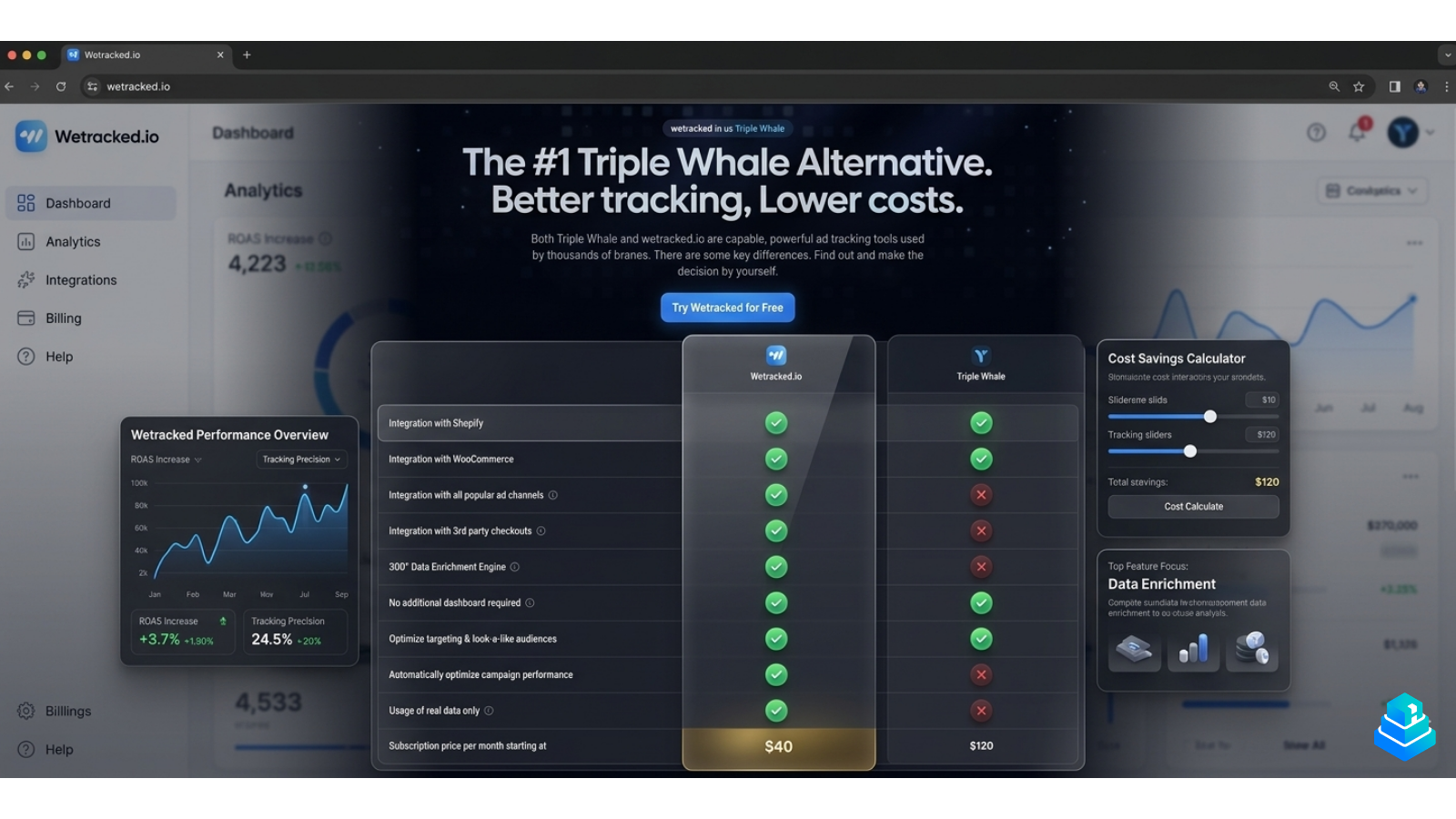
WeTracked and Triple Whale both target ecommerce attribution workflows, but their operational focus feels noticeably different once you move beyond the dashboard visuals. One leans into lightweight, server-side attribution clarity. The other leans into a broader analytics command center built around layered reporting. Neither is universally better — they answer different questions about how a Shopify brand wants to read its numbers.
We tested both platforms across Shopify reporting workflows, Meta attribution visibility, and ecommerce analytics use cases to understand where each one fits best. This comparison focuses on real workflow tradeoffs and what each tool actually feels like to use day to day — not feature checklists.
Quick verdict
What each platform is actually built for
WeTracked
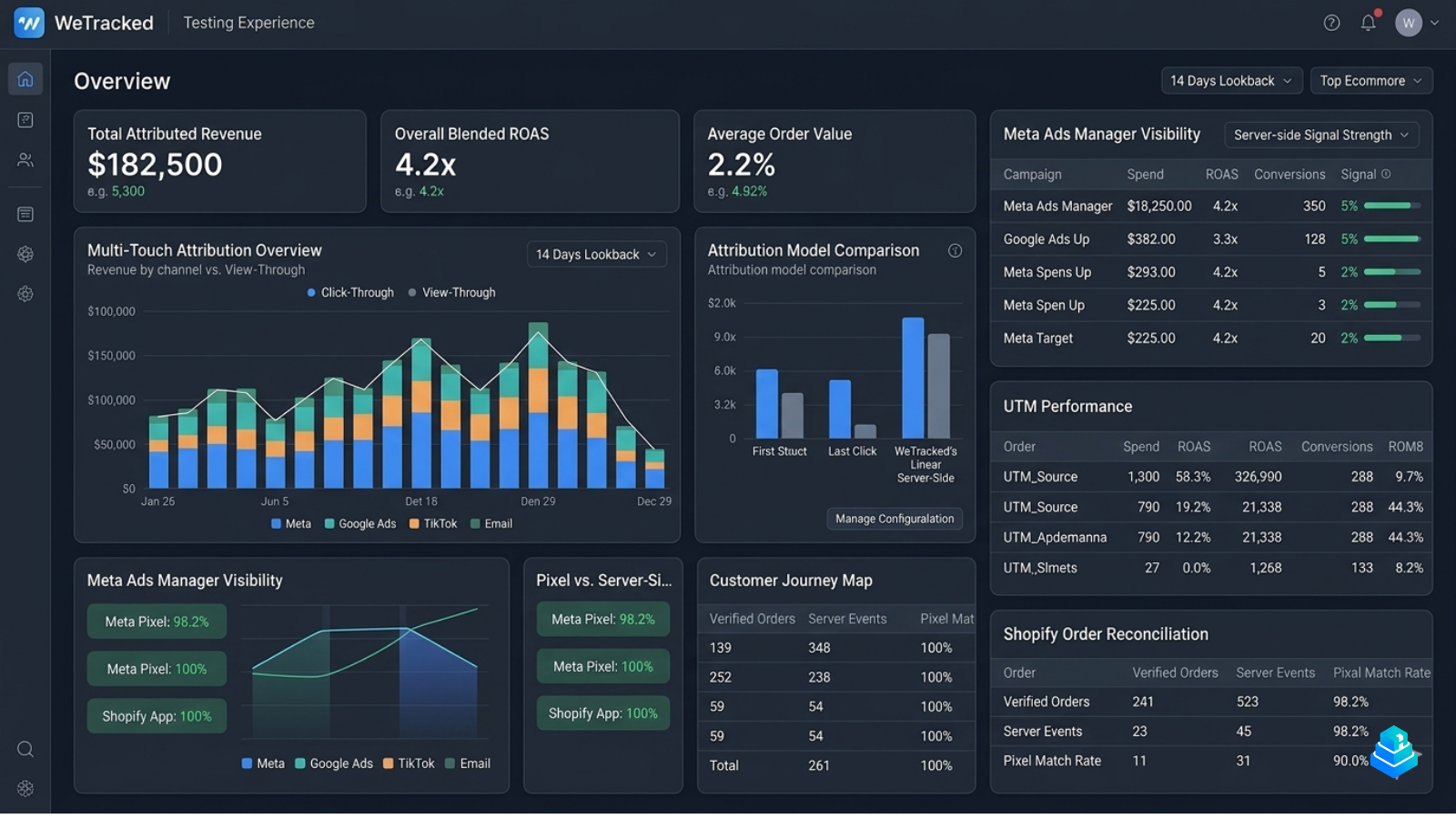
WeTracked is positioned around lightweight, server-side attribution for Shopify brands. The dashboard reflects that focus — it opens into a clean attribution overview with blended ROAS, multi-touch reporting, and a persistent emphasis on signal quality between Meta, Google Ads, TikTok, and Shopify orders. The product feels purpose-built for operators who want one view they can trust without juggling separate analytics tools.
Triple Whale
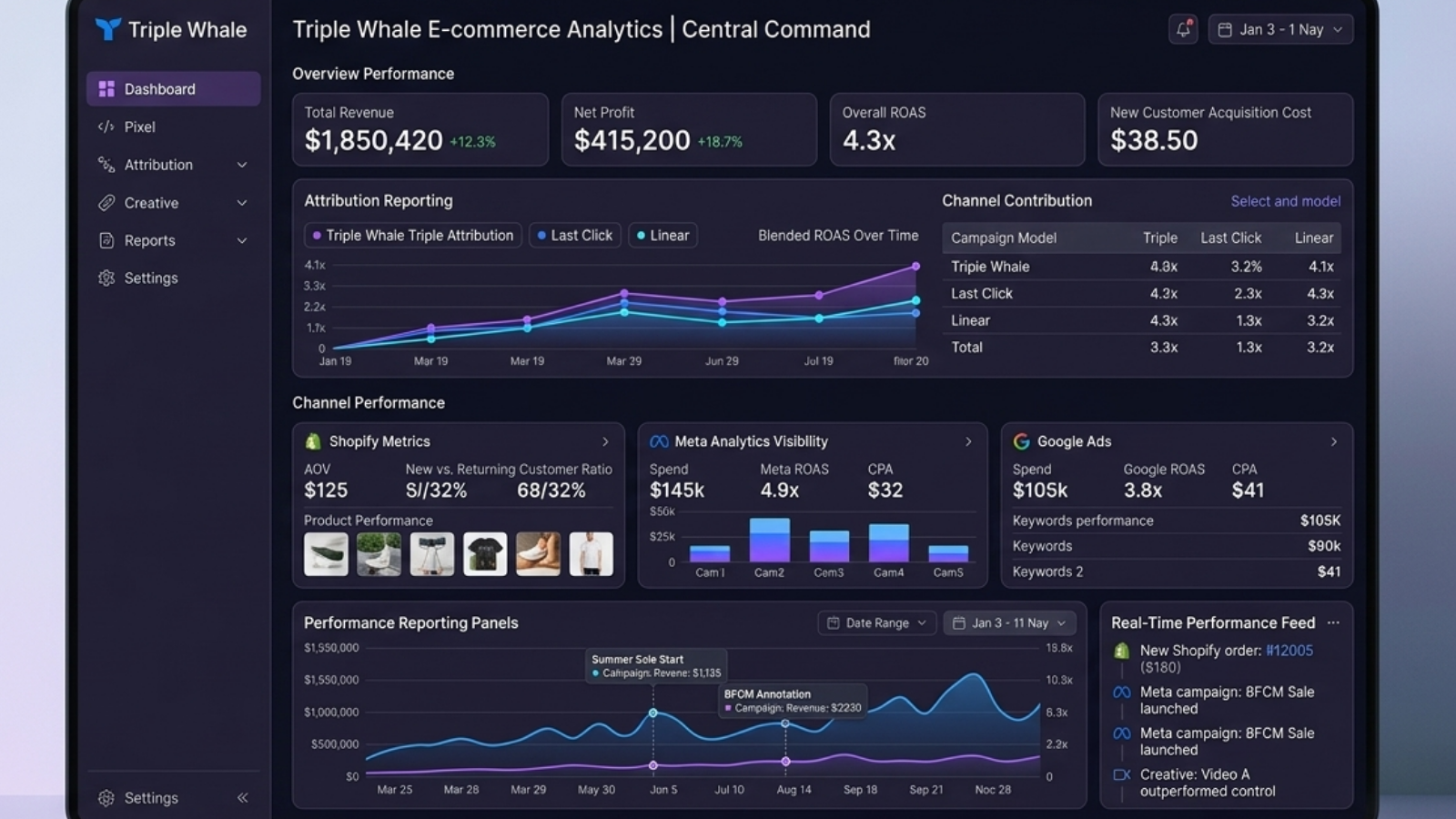
Triple Whale is built more like a centralized ecommerce command center. Attribution is one layer inside a broader environment that includes channel analytics, creative reporting, customer cohorts, and pixel-level event tracking. Larger Shopify brands and agencies tend to gravitate toward Triple Whale because it consolidates several reporting workflows into a single dashboard, even when individual layers overlap with other tools in the stack.
WeTracked feels like an attribution layer designed to be lived in. Triple Whale feels like an analytics environment designed to replace several tabs at once.
Our testing experience
We connected both platforms to the same Shopify store — a mid-sized DTC brand running paid traffic across Meta, Google, and TikTok — and ran them in parallel for several weeks. The goal was to evaluate onboarding, Shopify integration depth, Meta signal quality, dashboard usability, and how each tool handled day-to-day attribution questions from the media team.
Onboarding & Shopify integration
WeTracked's onboarding is intentionally narrow. You connect Shopify, add ad accounts, drop in a script or use the Shopify app, and you're looking at attributed revenue within a short window. Triple Whale's onboarding covers more ground — pixel installation, attribution model selection, channel connections, and customer data setup — which takes longer but unlocks more reporting layers downstream.
Meta tracking & event matching
Both platforms run a server-side layer to improve Meta event matching beyond what the standard pixel can capture, which is the core reason most teams adopt either tool in the first place. In our test, both recovered a meaningful share of post-iOS Meta conversions, and the reported numbers landed in a similar range across Shopify orders. WeTracked surfaces signal strength and pixel-vs-server-side match rates front and center on the dashboard. Triple Whale surfaces similar data, but it sits one or two clicks deeper inside its pixel and attribution modules.
Dashboard usability
WeTracked's interface stays close to a single working surface — totals, multi-touch overview, channel visibility, and Shopify reconciliation without much navigation. Triple Whale's interface is broader: a persistent left navigation moves between dashboard, pixel, attribution, creative, and reports. For a smaller team, that breadth can feel like extra surface area to manage. For an agency or larger in-house team, it usually feels like the point.
Reporting & attribution workflows
Attribution philosophies diverge slightly between the two platforms. WeTracked emphasizes a single multi-touch view supplemented by clear click-through and view-through data, with explicit Shopify order reconciliation surfaced on the same screen. Triple Whale offers a wider range of attribution models — first-click, last-click, linear, and its own blended model — and lets teams compare them side by side.
For brands that want one trusted number per channel, WeTracked tends to be faster to act on. For teams that want to see how a campaign performs under different attribution lenses before making a decision, Triple Whale's multi-model comparison is genuinely useful, especially during promotional windows where the attribution window matters.
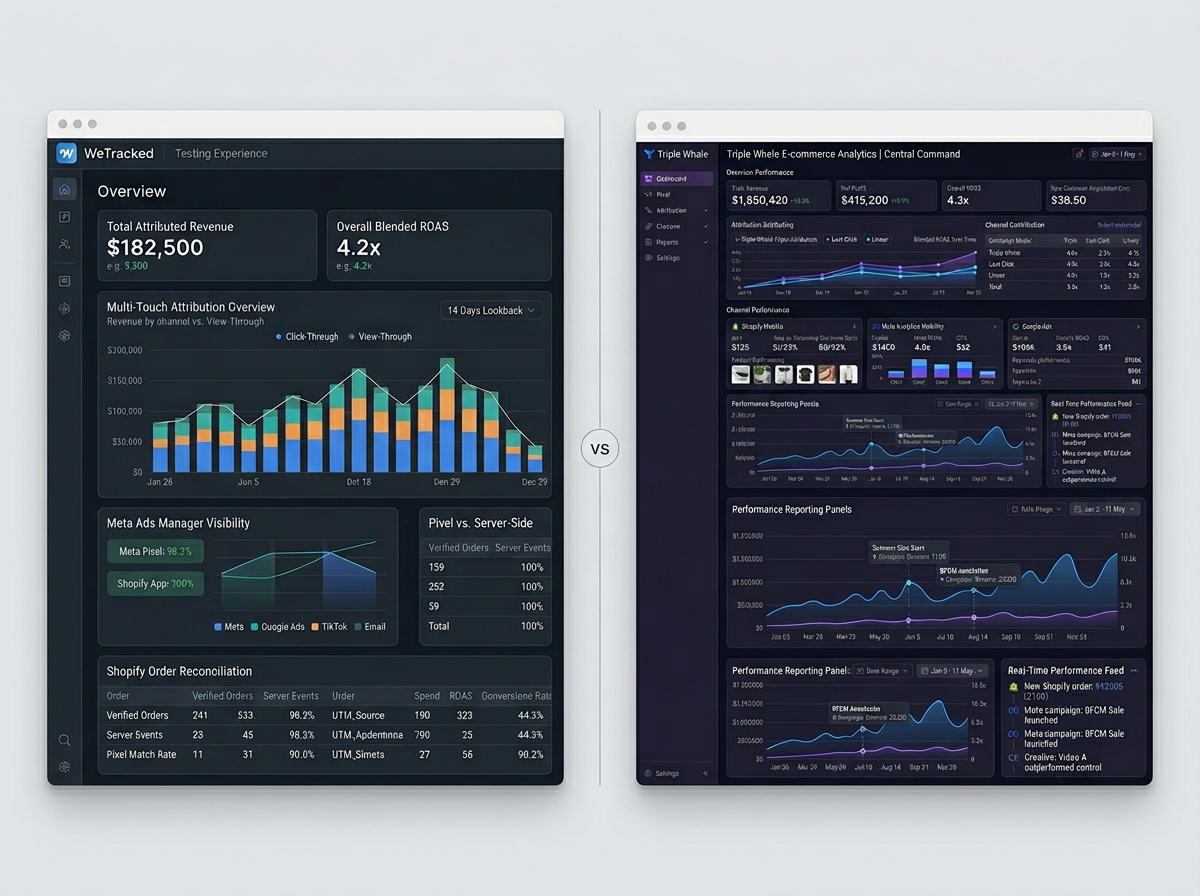
On Meta signal quality specifically, both tools made a noticeable difference compared to relying on the native pixel alone — which aligns with what most teams report when they move to a server-side setup. We cover that broader topic in our server-side tracking guide, which is worth reading alongside any tool decision in this category.
Dashboard experience
The clearest practical difference between the two platforms is the shape of the daily workflow. WeTracked is closer to a focused reporting surface — open it, read the numbers, act. Triple Whale is closer to an analytics workspace — open it, navigate, drill down, then act.
For a solo Shopify operator or a small in-house team, fewer screens usually means faster decisions. For an agency managing several brands or an in-house team with separate creative, media, and analytics roles, the extra navigation in Triple Whale tends to map more naturally to how the work is actually divided.
Pricing comparison
Pricing structures differ as much as the products. WeTracked's plans tend to start at a lower monthly entry point and scale based on tracked order volume, which generally favors small to mid-sized Shopify brands. Triple Whale's pricing scales with revenue tier and adds modules for things like creative analytics or advanced attribution, which generally favors larger brands or agencies that will use the broader environment.
Both companies update their plans regularly, so any specific number is best confirmed on the vendor's site at the time of evaluation. The more useful framing for a budget conversation is fit: WeTracked is usually the cheaper line item because it does less by design, while Triple Whale consolidates spending that might otherwise live across multiple tools.
Which tool fits which Shopify brand?
Small Shopify stores
For brands under roughly $1M in annual revenue, WeTracked usually fits better. The setup is faster, the dashboard is easier to read without an analyst, and the price is closer to the size of the operation.
Scaling brands
Once a brand crosses into the mid-seven figures and starts running paid media across multiple channels with separate creative and media owners, Triple Whale's broader environment starts to earn its weight — provided the team has bandwidth to actually use the deeper reporting.
Paid media teams
For paid media teams whose primary question is "is my Meta data trustworthy this week?", WeTracked is faster to that answer. For teams whose questions span creative testing, channel mix, and customer cohorts, Triple Whale offers more in one place.
Agencies
Agencies usually have a slight bias toward Triple Whale because clients expect a polished, multi-channel reporting environment. WeTracked still shows up in agency stacks, often as the attribution layer underneath a simpler client-facing report.
Pros & cons
WeTracked
- Focused attribution surface, fast to read
- Lightweight Shopify setup
- Lower entry pricing for small brands
- Limited creative & cohort analytics
- Fewer attribution model options
Triple Whale
- Broad ecommerce analytics environment
- Multiple attribution models side by side
- Strong fit for agencies and larger teams
- Heavier setup and learning curve
- Higher overall cost at scale
Alternatives worth considering
Northbeam sits closer to Triple Whale in scope — broader marketing analytics with media mix and incrementality features that tend to suit larger brands with dedicated analytics resources.
Hyros is more focused on ad-side attribution and call/lead tracking, often adopted by info-product and high-ticket DTC teams rather than typical Shopify apparel or beauty brands.
Elevar takes a different angle altogether — it focuses on the data layer and server-side event forwarding itself, and is frequently paired with one of the reporting tools above rather than used as a replacement for them. Our roundup of the best ad tracking tools covers how these platforms tend to overlap and where the meaningful differences sit.
Frequently asked questions
Final verdict
For Shopify brands prioritizing lightweight attribution visibility and operational simplicity, WeTracked feels more streamlined and is usually the faster path from install to a number the media team trusts. Triple Whale offers a broader analytics environment that tends to appeal more to agencies and larger in-house teams that want centralized reporting and multiple attribution lenses in one place.
Neither platform is the right answer for every store. The realistic framing is whether your team wants a focused attribution layer or a full ecommerce analytics workspace — and which of those your current stack is actually missing. Our full WeTracked review covers the platform in more detail if you want a deeper look at one side of the comparison.
Explore both platforms
The fastest way to decide is a short, parallel test on your own Shopify store. Most teams know within a couple of weeks which workflow they actually prefer.
Explore both platforms