
Server-Side Tracking Guide for Shopify Brands
A practical, technical look at how server-side tracking actually works in ecommerce — why browser-side tracking broke, what changed with iOS, and how modern Shopify brands implement reliable attribution with tools like Elevar, WeTracked, and Triple Whale.
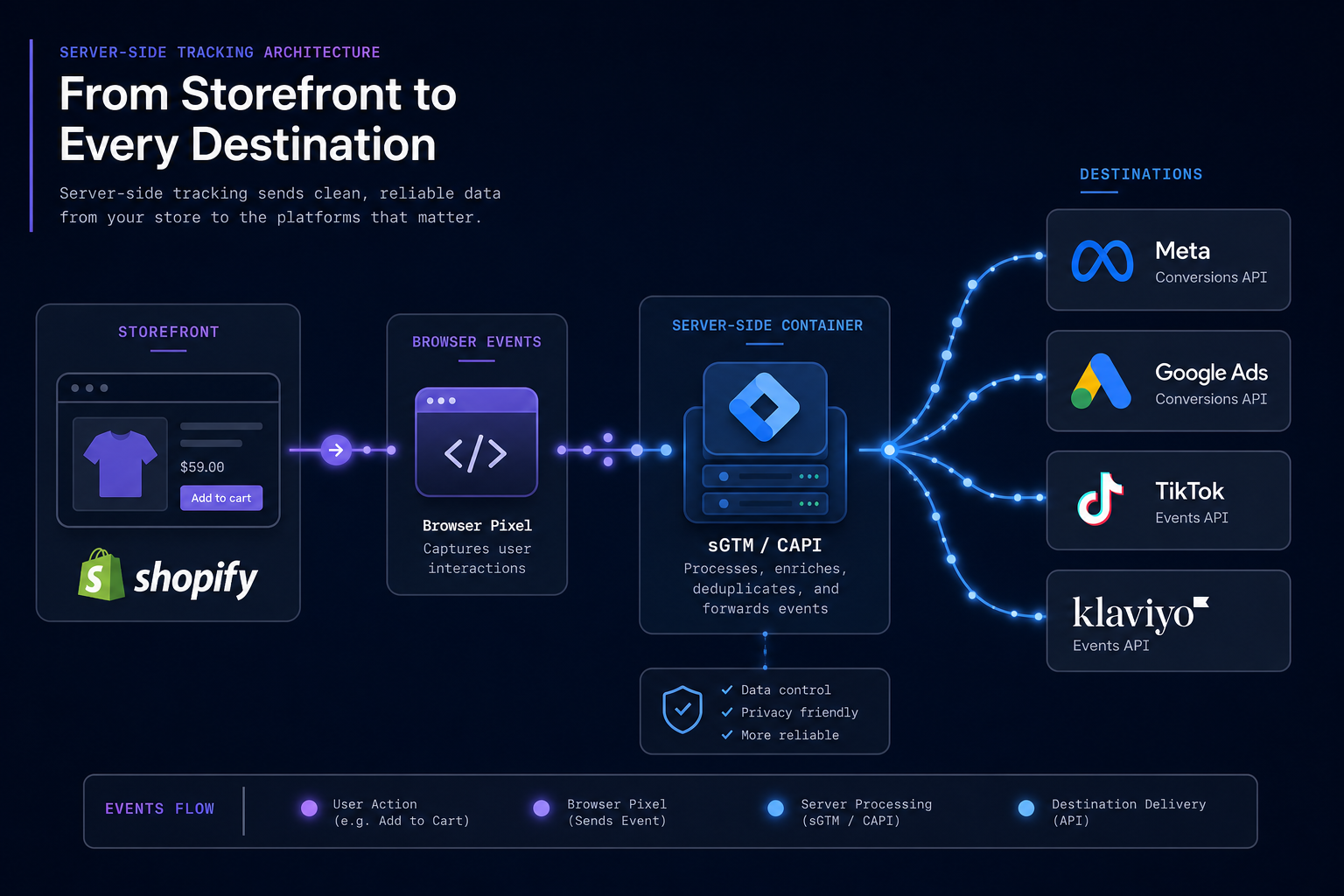
Server-side tracking has gone from a niche infrastructure topic to a baseline expectation for ecommerce brands running paid media at any meaningful scale. But despite how often the term is used, the actual mechanics are still poorly understood — and a lot of the marketing around it overstates what it can and can't do.
This guide is intended as an editorial, technical reference. It walks through how server-side tracking works in real Shopify stacks, why it became necessary, where it genuinely helps, and where the limits are. There are no affiliate links and no claims about "fixing" attribution. The goal is simply to give operators an honest mental model.
What server-side tracking actually is
At a technical level, server-side tracking means that ecommerce events — page views, add-to-carts, purchases, and so on — are sent to ad platforms and analytics destinations from a server that you (or a tracking vendor) control, rather than directly from the visitor's browser.
In a traditional browser-side setup, a JavaScript pixel fires inside the shopper's browser and sends events directly to platforms like Meta or Google. That request is subject to ad blockers, browser privacy features, third-party cookie restrictions, and connection failures. A server-side setup instead routes those events through a server endpoint — typically a server-side Google Tag Manager container, a Conversions API integration, or a managed tool like Elevar — which then forwards cleaner, deduplicated payloads to each destination.
Why browser-side tracking became unreliable
Browser-side tracking still technically works — but it has degraded significantly over the last few years. There are several overlapping reasons:
- Ad blockers and content blockers. A meaningful share of ecommerce traffic blocks third-party pixels entirely. Those events never reach Meta or Google in a browser-only setup.
- Browser privacy features. Safari's Intelligent Tracking Prevention, Firefox's Enhanced Tracking Protection, and Chrome's evolving cookie policies have all chipped away at third-party cookie reliability.
- Network instability. Browser-side requests fail silently more often than people realize — especially on mobile connections during checkout.
- Limited control over payloads. Browser-side events are constrained to whatever data the front-end has, and are harder to enrich with order-level information.
The result is that browser pixels routinely under-report purchases, which directly affects how ad platforms optimize and how brands evaluate ROAS.
iOS privacy changes and attribution loss
Apple's App Tracking Transparency framework, introduced with iOS 14.5, was the inflection point most ecommerce teams remember. The change limited Meta's ability to receive deterministic in-app conversion signals from iOS users, which immediately disrupted how Shopify brands measured and optimized Meta campaigns.
The downstream effects went well beyond Meta. Attribution windows shortened, modeled conversions became more prominent, and the gap between in-platform reporting and Shopify's own order data widened. Server-side tracking emerged as a partial answer because it gave brands a way to send first-party event data directly from their own infrastructure rather than depending solely on browser pixels.
iOS didn't break attribution. It exposed how fragile browser-only attribution had always been.
Why Meta conversion tracking is a recurring problem
Meta is usually where the cracks become visible first. The combination of iOS limitations, dedup requirements between browser and server events, and Meta's own modeling means that ROAS reported inside Ads Manager rarely matches what Shopify shows for the same period.
Server-side tracking, specifically Meta's Conversions API (CAPI), addresses several of these problems by allowing brands to send events from their server with stronger identifiers — hashed email, phone number, IP, and user agent — alongside the browser pixel events. When paired correctly with deduplication, this typically improves event match quality, which is the score Meta uses to decide how confident it is in the identity of a converted user.
None of this makes Meta's reporting "true." It just makes the signal cleaner so the optimization algorithm has a better chance of finding real customers.
Shopify attribution workflows in practice
Shopify brands typically run attribution across at least three layers simultaneously: the ad platform's own reporting, Shopify's order data, and a third-party attribution tool that reconciles between them. Each of those layers has different assumptions, and server-side tracking sits underneath all of them as the data foundation.
In a healthy Shopify stack, the typical flow looks something like this:
- The browser pixel captures session-level interactions.
- A server-side container or vendor (e.g. Elevar) receives those events.
- Events are enriched with first-party Shopify order data.
- Deduplicated, well-formed payloads are forwarded to Meta CAPI, Google Ads, TikTok Events API, GA4, and Klaviyo.
- An attribution tool sits on top to interpret the resulting numbers for marketers.
For a deeper comparison of the reporting layers that sit on top of this pipeline, see our best ad tracking tools guide.
How server-side tracking improves signal quality
The biggest realistic gains from server-side tracking are not in "recovering lost conversions" — that framing oversells what the technology can do. The real improvements are more structural:
- Higher event match quality. Server-side payloads can include richer identifiers that browsers don't easily expose, improving how often events are matched to a known user.
- More reliable delivery. Server requests are not affected by ad blockers and have far lower silent-failure rates than browser requests.
- Cleaner deduplication. When browser and server events are deduplicated correctly, ad platforms see one event per purchase instead of inflated double-counted conversions.
- Better data control. You decide what's sent, when, and to which destinations — not the browser's runtime.
Common server-side tracking setups
There is no single "correct" architecture. The most common setups in Shopify-led ecommerce stacks fall into three patterns:
1. Server-side GTM (sGTM)
A Google Tag Manager server container hosted on your own subdomain. Powerful and flexible, but requires technical ownership and ongoing maintenance. Often the choice for in-house data teams.
2. Managed tracking platforms
Tools like Elevar handle the infrastructure on your behalf, with pre-built Shopify and destination integrations. Faster to deploy and easier to maintain than a raw sGTM build.
3. Built-in attribution tool pipelines
Some attribution platforms ship their own server-side pixel (WeTracked, Triple Whale's Sonar) that handles event forwarding inside the same product used for reporting. Simpler operationally but more coupled to the vendor.
Tools we tested
We focused on three tools that show up most often in Shopify-led stacks. None of them are universally "best" — they solve overlapping but different problems.
WeTracked — attribution-first with server-side events
WeTracked positions itself primarily as an attribution dashboard, but ships server-side event forwarding into Meta CAPI as part of its core workflow. For Shopify stores running predominantly on Meta, the combined attribution + server-side flow keeps the stack small.
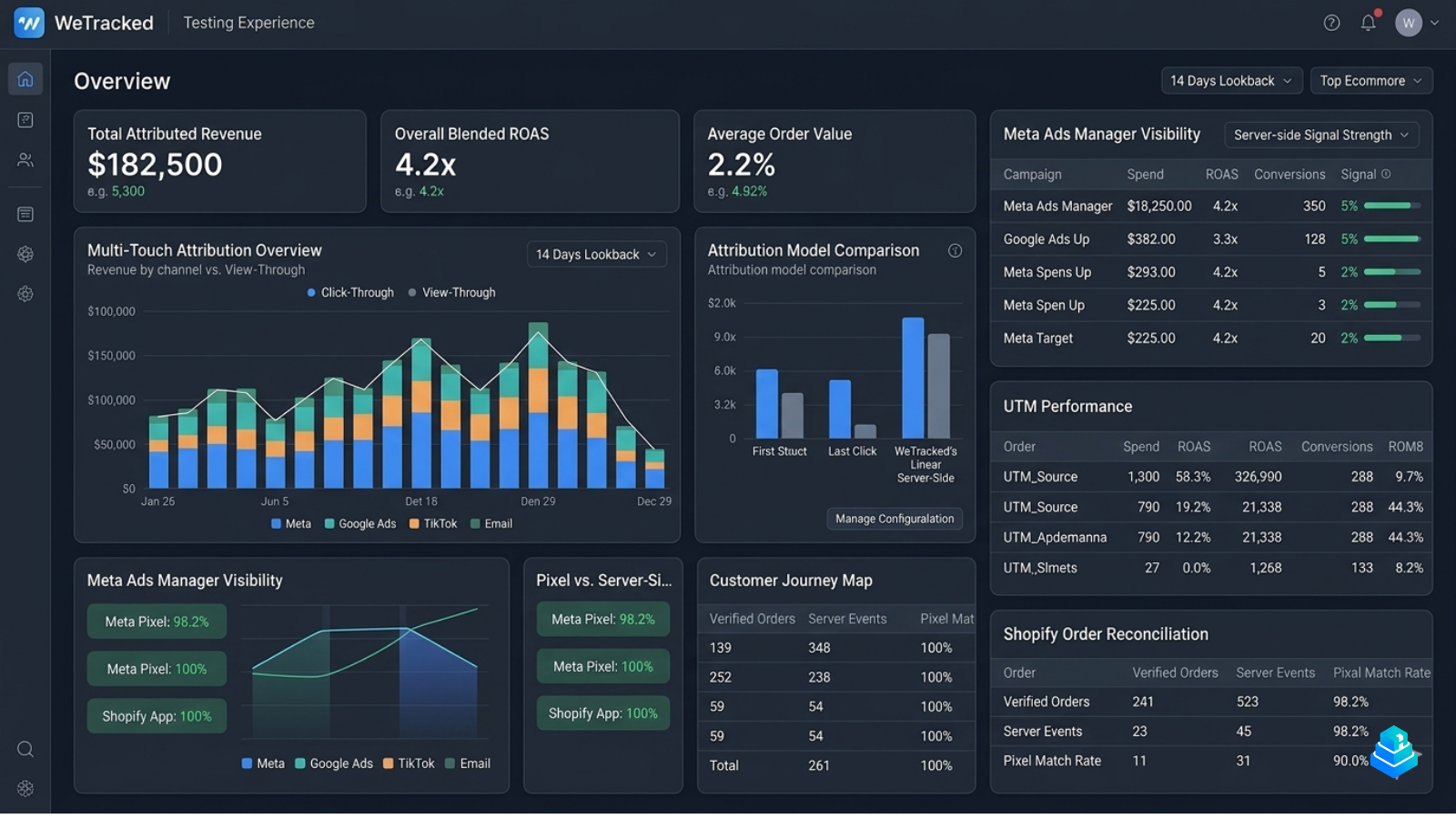
See the dedicated WeTracked review and the WeTracked vs Triple Whale comparison for more detail.
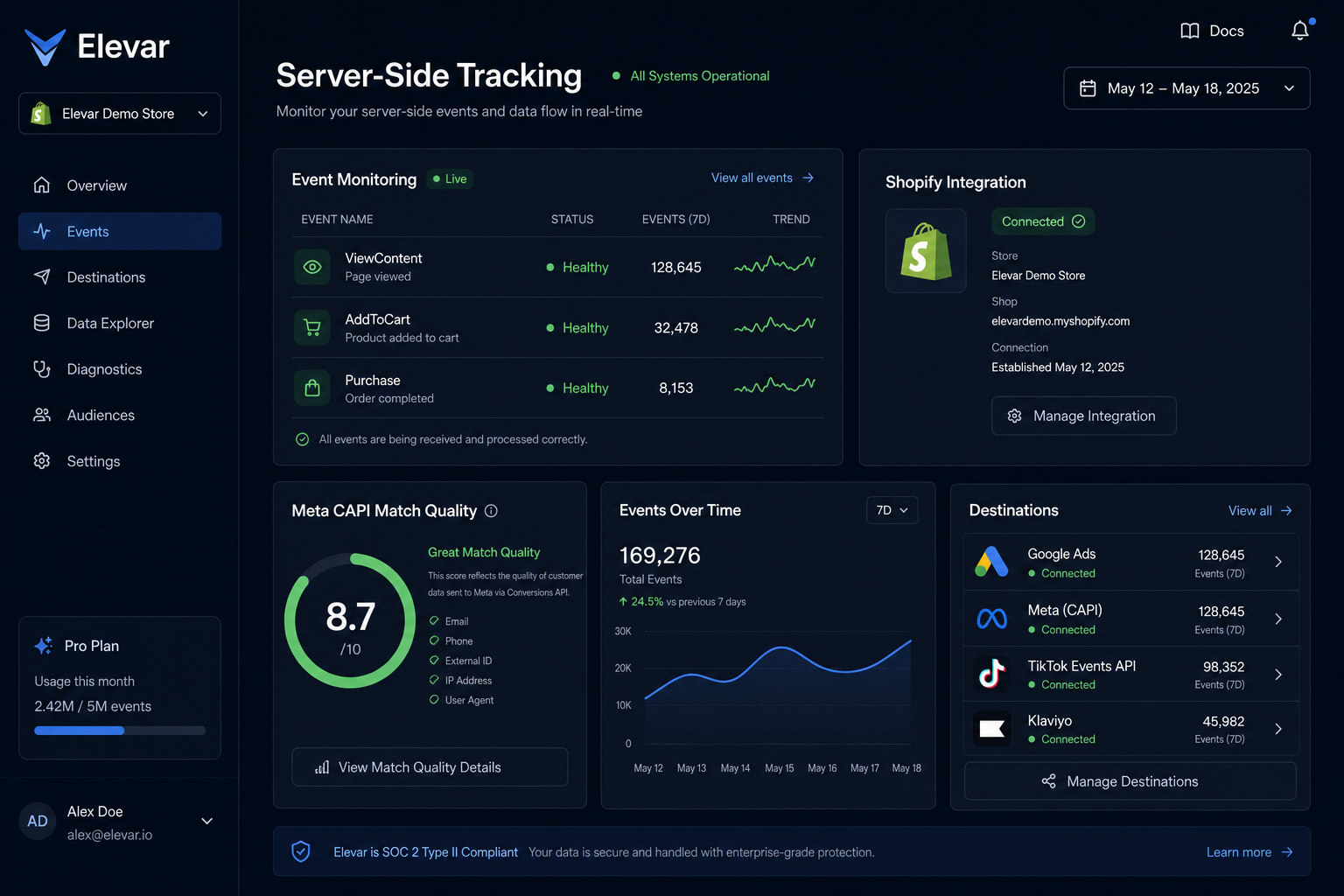
Elevar — dedicated server-side tracking infrastructure
Elevar is the most infrastructure-focused tool in this group. The platform is built around event monitoring, CAPI match quality, and destination management for Shopify-native stores. It is not an attribution dashboard — it's the layer that makes the data going into attribution dashboards more reliable.
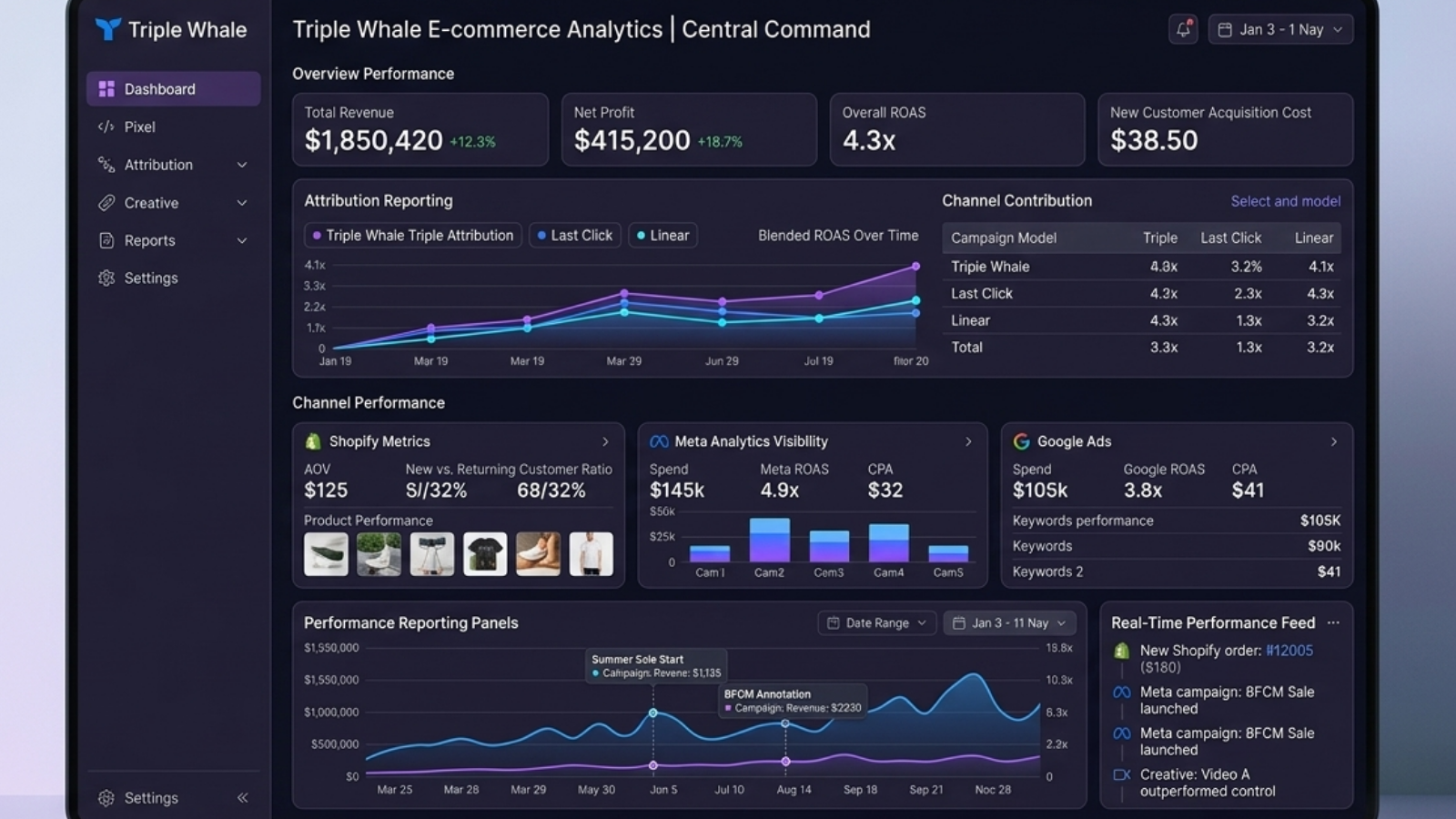
Triple Whale — analytics-first with built-in pixel
Triple Whale's Sonar pixel handles its own server-side event flow as part of a broader ecommerce analytics platform. For brands that want attribution, Shopify analytics, post-purchase surveys, and creative reporting consolidated in one place, the integrated approach reduces the number of moving parts.
Limitations and misconceptions
Server-side tracking is genuinely valuable, but it is routinely oversold. A realistic view of what it does not do is just as important as understanding what it does.
- It does not bypass consent. If a user declines tracking, server-side delivery doesn't change that.
- It does not "recover" all lost conversions. Some conversions are unmatchable regardless of how cleanly events are delivered.
- It does not make Meta and Shopify numbers reconcile. Different attribution windows and modeling will always produce different totals.
- It is not a one-time setup. Destinations evolve, Shopify themes change, and event schemas shift. Tracking is ongoing maintenance.
Common implementation mistakes
- Forgetting deduplication. Sending both browser and server events without proper
event_iddeduplication inflates conversions and corrupts optimization. - Inconsistent event schemas. Sending different field names or value formats from browser vs. server breaks matching.
- Ignoring match quality scores. Meta's event match quality score is one of the few direct feedback signals available — leaving it unmonitored is a missed opportunity.
- Skipping consent integration. Server-side tracking still needs to respect consent state. Forgetting this is both a compliance and a data-quality risk.
- Treating it as set-and-forget. Theme updates, checkout changes, and destination API updates all break tracking over time.
Frequently asked questions
A balanced editorial conclusion
Server-side tracking is one of the few infrastructure investments in ecommerce that has aged well. It improves data quality, hardens the tracking layer against browser and platform changes, and gives attribution tools a more reliable foundation to report on. None of that requires hype — the technology stands on its own merits.
The right implementation depends on team size, spend, and how much internal ownership you want over the tracking stack. Smaller brands often start with a managed approach inside an attribution tool like WeTracked. Larger brands typically end up running Elevar (or an equivalent) underneath a dedicated reporting layer such as Triple Whale or Northbeam. There is no single correct architecture — only the one your team can maintain and trust.