
Holo AI Review: Can It Actually Help Ecommerce Brands Produce Better Ad Creatives?
Most ecommerce brands don't lose because their product is bad. They lose because they can't ship enough creatives to keep an account alive. Meta fatigue starts hitting around day four. A TikTok hook burns out in 48 hours. And the editor you briefed last Tuesday is still "doing one more pass" on the batch you needed live yesterday.
That's the actual bottleneck for most Shopify and WooCommerce brands in 2026 — not strategy, not targeting, not pixel setup. It's throughput. So when an AI ad tool like Holo AI shows up promising faster variations and TikTok-ready outputs, the only question that matters is whether it actually helps you push more tests this week, or whether it's just another tab open in the background.
I spent a few weeks running Holo AI inside a real ecommerce testing workflow — Meta cold campaigns, TikTok Spark-style ads, a couple of product validation tests. What follows is what I'd tell another operator over coffee. Not a feature tour.
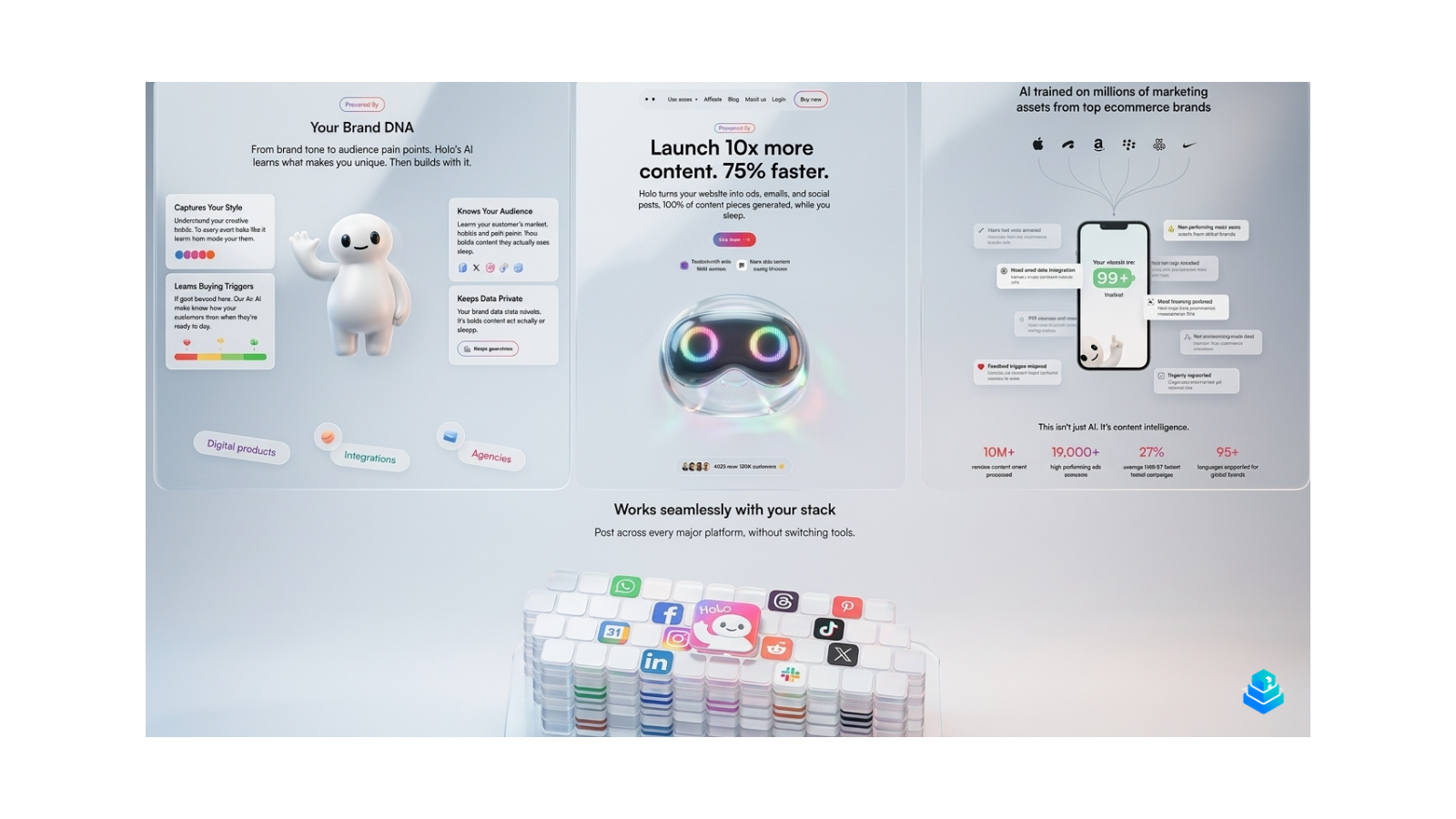
Why Most Ecommerce Brands Struggle With Creative Testing
Talk to any DTC operator running paid media seriously and the same pattern shows up. The strategy is fine. The product is fine. The offer is fine. What's broken is the creative pipeline behind it.
A small Shopify brand might ship two or three new ad variations a week. A growing one might push five to ten. The brands actually scaling on Meta and TikTok? They're testing 30 to 80 fresh creatives a month, sometimes more. That gap isn't talent. It's throughput, and it compounds quietly until the account stops responding to budget.
The blockers are always the same. Editors charge $80–$200 per ad and disappear for a week. UGC creators take 7 to 14 days to deliver. Your in-house designer is buried under product photography. Nobody wants to be the one who relaunched the same losing hook from last month, so testing volume quietly drops, ROAS decays a few points at a time, and everyone wonders why "the account stopped working."
Most operators I talk to don't need a smarter creative — they need ten more shots on goal this week without burning another $1,500 on freelancers.
You can feel this in the Slack threads. Briefs sit in Notion for three days. The freelancer pushes a v1, then a v2, then ghosts until Monday. Meanwhile the ad set you launched last week is quietly drifting from a 2.4 ROAS to a 1.6, and nobody on the team has the bandwidth to refresh the hook. By the time fresh creative lands, the audience has already seen the old one four times.

I Tested Holo AI Inside A Real Ecommerce Workflow
To make this review actually useful, I didn't poke at Holo AI on a hypothetical product. I plugged it into an active store testing a mid-ticket accessory (~$59 AOV) on Meta and TikTok. The goal was simple: keep ad sets fed with fresh variants for two weeks without burning out a freelancer or breaking the creative budget.
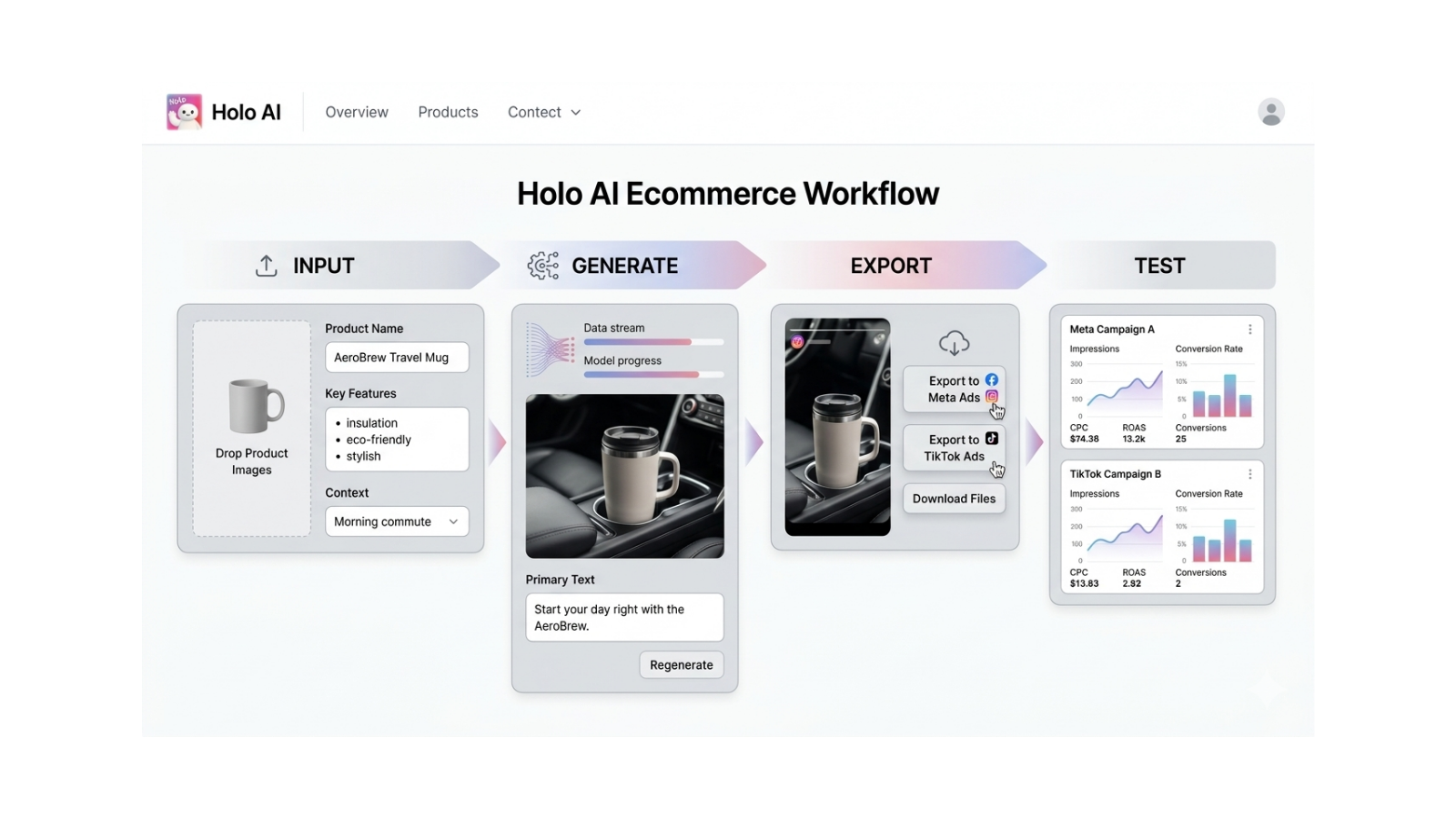
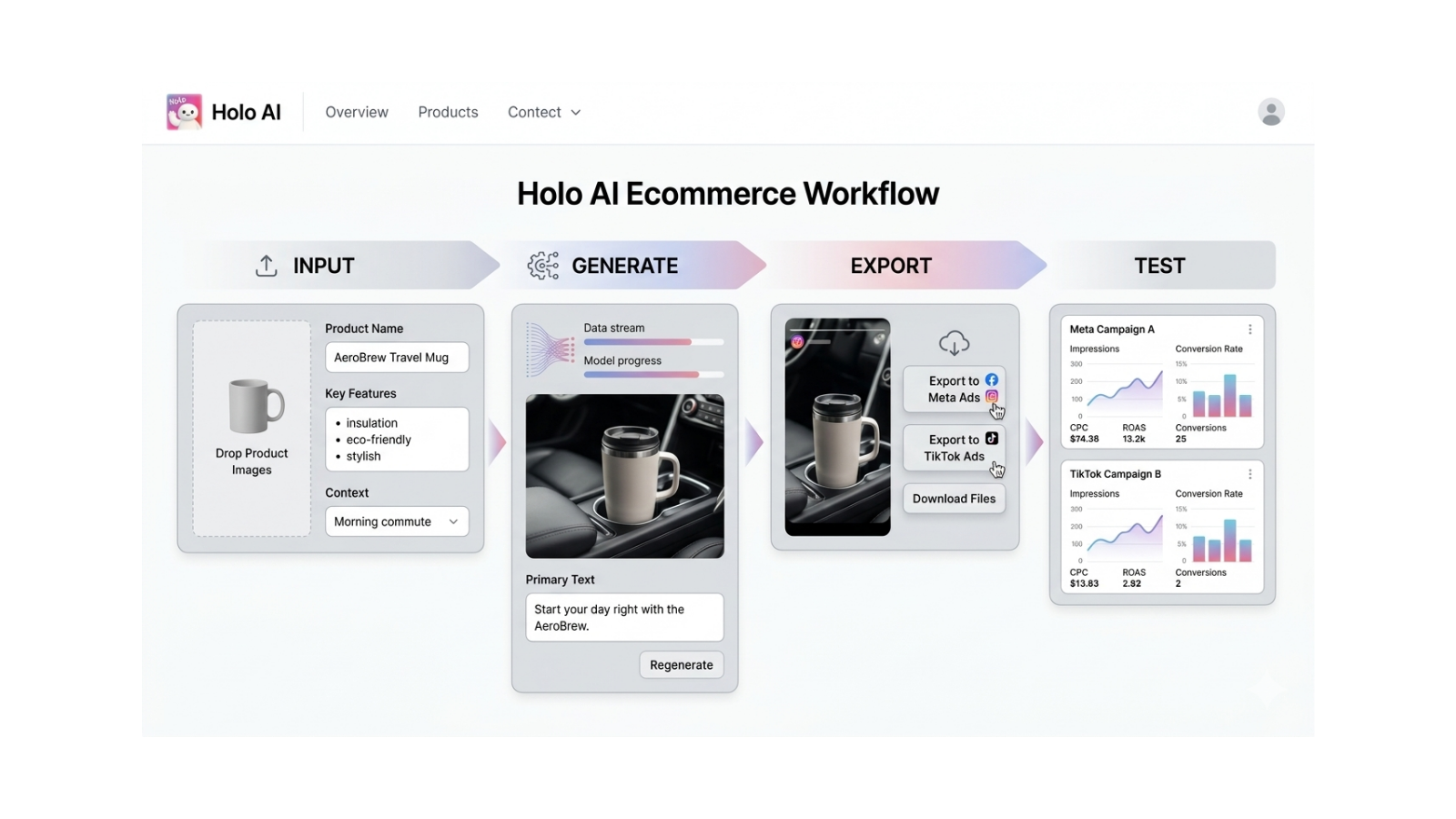
The loop looked like this — drop in product imagery, define the angle (problem-solution, social proof, before/after, founder POV), let Holo AI generate variations, throw out the obviously weak ones, export, push live. Repeat every two or three days.
What stood out first was the compression. Generating five hook variations of the same TikTok-style ad took minutes, not days. For a solo operator running ads on the side, that turns a week of back-and-forth into a single afternoon. Not all of them were usable — maybe four out of ten were worth running — but four new variants in an afternoon still beats waiting until Friday for a freelancer to send one.
What didn't stand out: anything cinematic. The outputs are clearly built for direct-response ad testing — short, punchy, hook-first — not brand films. If you came in expecting Apple launch energy, you'll be unhappy. If you came in needing 20 prospecting variants by Monday, you'll be relieved.
A few specific observations from running it daily. Hooks burn out fast on TikTok — usually inside 48 to 72 hours on a warm ad set. Having a rough variant ready before the old one tanked changed the rhythm of the account. Instead of scrambling on Friday for a "creative refresh," I had three new angles already queued up by Wednesday morning. Not all of them performed, but the cadence itself made the account feel less fragile.
What Holo AI Actually Does Well
The strongest case for Holo AI isn't that it makes amazing ads. It's that it lowers the cost of trying an angle to almost nothing. That alone changes how an operator approaches testing — you stop protecting your freelancer hours and start treating creatives like the disposable assets they actually are.
Three things genuinely worked in testing:
- Rapid hook iteration. Pulling 8–12 hook variants of the same product in under an hour means you can actually run a real hook test instead of guessing which line to put on the brief.
- Volume for cold traffic. For prospecting, where novelty matters more than polish, the tool fills the pipeline well enough to keep ad sets out of fatigue between proper UGC drops.
- Solo operator leverage. If you don't have an in-house editor, it removes the worst part of testing: waiting on someone else to render a 12-second video.
None of that makes it a creative director. It makes it a throughput tool. That's the right frame.
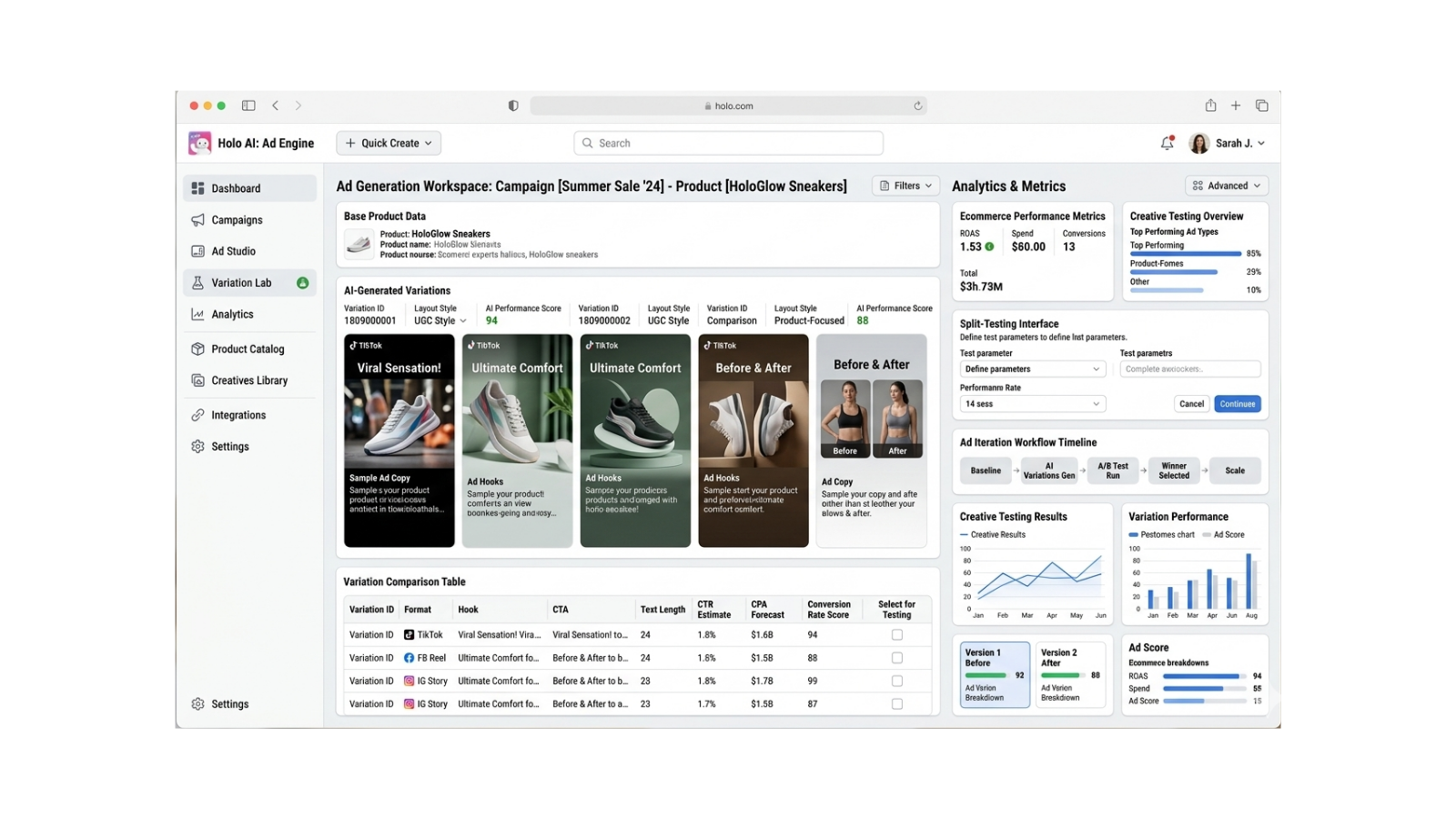
One small note worth flagging: the per-variant performance estimates Holo AI surfaces are interesting as a directional signal, but I wouldn't make budget decisions on them. Real CPM and CTR inside Ads Manager always told a different story than the in-app numbers. Use the previews to cull obvious losers, then let Meta and TikTok decide the rest.
Curious how the workflow looks in practice?
Explore Holo AI →Where Holo AI Still Falls Short
Honest part. Holo AI is not magic, and pretending otherwise would waste your money.
- Outputs can feel repetitive. Generate enough variations and you start seeing the same camera framing, same pacing, same B-roll patterns. Good for prospecting, tiring for scaled retargeting.
- Prompts matter — a lot. Lazy inputs produce lazy outputs. The operators getting real value out of these tools treat prompt-writing like a brief, not a search query.
- It still looks AI-generated sometimes. Certain hand movements, transitions, and overlay text give it away. Not a deal-breaker for cold traffic, but it's noticeable.
- Not built for cinematic branding. If your brand sells on aesthetic — fashion, jewelry, premium home goods — Holo AI is the wrong tool to lead with.
How I Would Personally Use Holo AI For Ecommerce
If I were running a Shopify store today and adding Holo AI to my stack, I wouldn't replace anything. I'd slot it into three specific jobs:
- New product validation. Before paying for UGC, I'd generate 6–10 AI variations to see which angle gets traction on cold TikTok traffic for $50–$100.
- Hook testing for Meta. Same product, same body, 10 different hooks. Use Holo AI to generate the variants, push them as a hook test, then brief the freelancer only on the winners.
- Filling cold ad sets. Prospecting campaigns eat creative. Using AI for that layer frees up budget and human hours for retargeting and brand content that actually needs polish.
Holo AI vs Traditional Ecommerce Creative Workflows
The honest comparison isn't "Holo AI vs human editors." It's "Holo AI vs the parts of the workflow that are actually slowing you down."
- vs Freelancers: Faster and cheaper for variation work. Worse for anything requiring taste, brand voice, or original concepting.
- vs Agencies: Agencies still win on strategy and high-production assets. Holo AI wins on volume between those drops.
- vs Manual CapCut workflows: CapCut is free and flexible, but it doesn't scale past one person's attention span. Holo AI compresses the boring middle steps.
- vs UGC creators: UGC still converts better in most categories. The right move is using Holo AI to figure out which angles are worth paying a real creator to film.
Who Should Use Holo AI
Holo AI is a strong fit for operators who are creative-starved and time-poor. Specifically:
- Dropshippers validating new products on TikTok and Meta.
- Shopify stores under ~$200K/month that can't yet justify a full-time editor.
- WooCommerce brands managing creative in-house with a small team.
- Solo operators running ads without an internal creative department.
- Media buyers who need a steady stream of cold-traffic variants without booking the design team every week.
Who Should Avoid It
And being just as direct — Holo AI is the wrong call for some brands:
- Luxury or aspirational brands that live or die by aesthetic consistency.
- Brands building cinematic, story-driven campaigns that need real direction and casting.
- Operators expecting one-click winning ads without a real testing framework behind them.
- Stores with no clear angle, offer, or audience defined yet — AI won't fix a positioning problem.
Final Verdict
Holo AI isn't a magic ad machine, and the brands trying to use it like one will be disappointed. But for ecommerce operators who already understand creative testing — and just need more reps, faster — it earns a real place in the stack.
Used inside a thoughtful workflow, it can take a store from shipping 3 ads a week to shipping 15, and that gap alone is usually the difference between a flat account and a scaling one. Used as a shortcut to skip strategy, it'll just produce more mediocre ads, faster.
That's the honest read. It's a workflow tool. Treat it like one and it pays back its cost. Treat it like a creative director and you'll be unhappy.
Curious how the workflow looks in practice?
See how the Holo AI workflow works →FAQ
Is Holo AI good for TikTok ads specifically?
Yes — TikTok-style short-form is where it performs best. Hook-driven, fast-cut, product-forward. For longer brand storytelling, it's a weaker fit.
How does Holo AI compare to Pictory?
Pictory is built more for repurposing long-form content into short videos. Holo AI is built for generating ad variations from product inputs. Different jobs — operators running paid media usually find Holo AI closer to their workflow.
Will the ads look obviously AI-generated?
Sometimes. For cold prospecting that's usually fine. For warm retargeting and brand-aware audiences, you'll want to mix in real UGC.
Is Holo AI worth it for a small Shopify store?
If you're shipping fewer than 5 creatives a week and that's your bottleneck — yes, the math usually works. If your bottleneck is strategy or product, fix that first.
Can it replace UGC creators?
No, and trying to replace them outright is the wrong frame. Use Holo AI to find which angles work, then pay UGC creators to film the winners properly.
Written by the Toolstacker editorial team — operators and media buyers reviewing ecommerce software from inside real Shopify, WooCommerce and dropshipping workflows. We don't accept payment for placement. Related reading: Holo AI vs Creatify, Best AI Video Tools for Ecommerce, AI Video Ads That Actually Convert.